
Executing the Sale of a Legacy 24-Unit Industrial Park
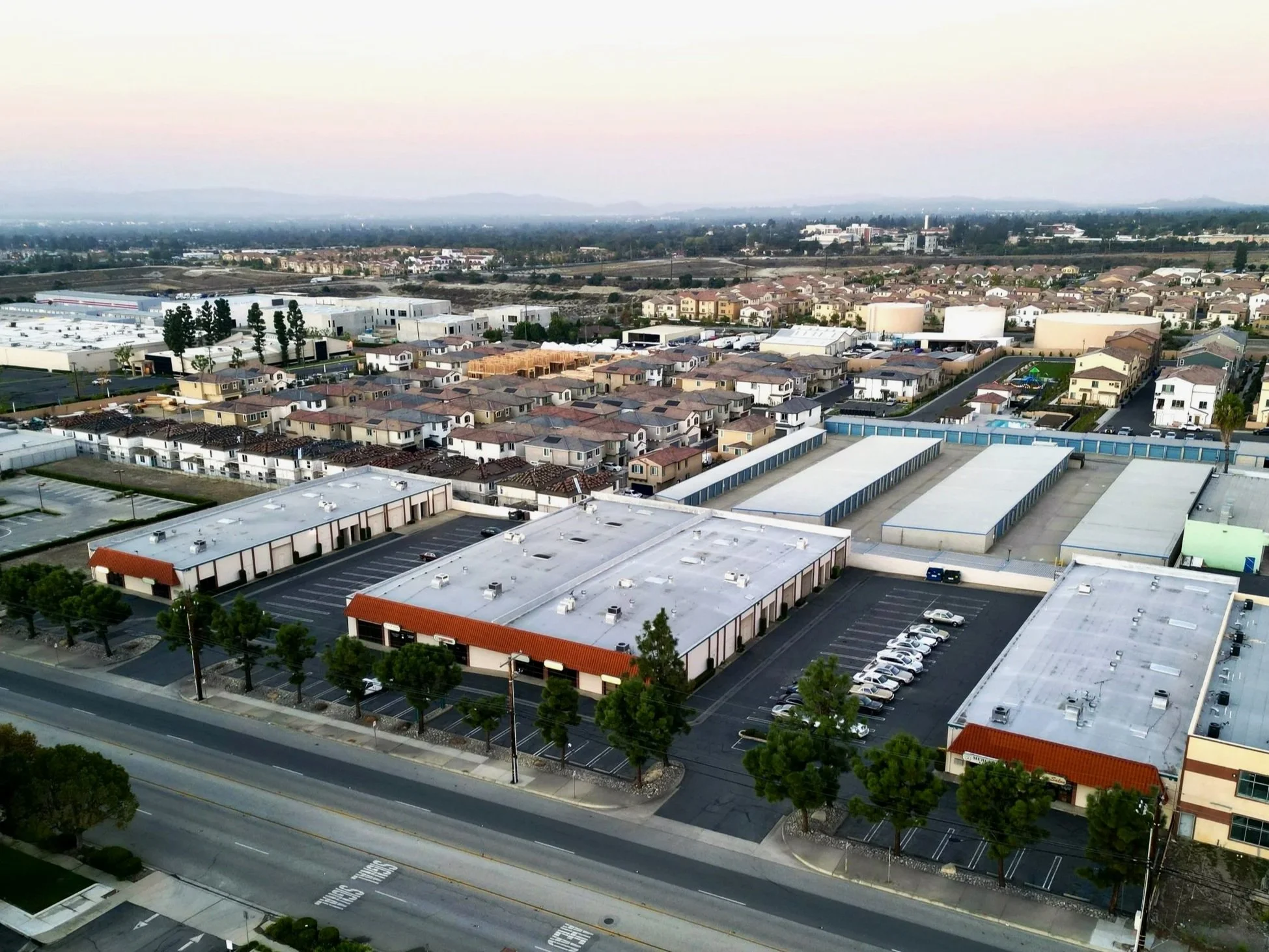
Aerial view of Central Park, a 24-unit mixed-use small-bay industrial property in Upland, California.
In December 2023, a 24-unit small-bay industrial park in Upland, California was brought to market following a partnership dissolution after decades of ownership.
Built in 1980 by the original ownership and held long term, this was not a distressed sale, nor was there 1031 pressure. It represented a generational transition.
The property ultimately sold for $8,828,625, reflecting approximately a 3.5% cap rate on in-place income and approximately 4.3% assuming lease-up and rent normalization to then-current market rents.
The outcome was the result of disciplined execution.
The Asset Profile
Central Park consisted of three masonry buildings totaling approximately 45,700 square feet on 2.39 acres.
Key characteristics:
Built 1979–1980
12’ clear height
Not sprinklered
On septic
Roof restoration system installed in 2020
Commercial Industrial Mixed Use (C/I-MU) zoning
Approximately 27% of the rentable square footage consisted of professional frontage along Central Avenue, with the balance configured as small-bay industrial.
The property was presented consistent with its mixed-use zoning and established operating pattern.
The Income Profile
At the time of marketing:
Approximately 90% occupied
13 of 19 leases were month-to-month
Weighted average in-place rent: $0.83/SF
Market rent assumption: $1.55/SF
Some tenants had occupied units for over 30 years. Rent increases had been implemented annually, though conservatively. Several units were materially below prevailing market rents.
Three units were intentionally vacant at marketing to preserve flexibility.
At the final sale price of $8,828,625:
In-place NOI (adjusted for post-sale property tax reassessment) equated to approximately a 3.5% cap rate.
Assuming lease-up of vacant units and normalization to then-current market rents, stabilized yield equated to approximately 4.3%.
This was not a stabilized asset. It was a legacy multi-tenant park with embedded rent reset flexibility and operational control.
Capital Environment and Buyer Profile
Prior to marketing, discussions with a national lender indicated that acquisition leverage at prevailing pricing would likely be conservative — approximately 30% loan-to-value.
At that leverage level, debt offered limited return enhancement relative to the in-place yield. Pricing was expected to be driven primarily by equity capital rather than aggressive leverage.
All offers were non-contingent cash.
The buyer was local private capital that owned nearby industrial parks and understood the small-bay service and auto-oriented tenant base. The buyer profile aligned with the asset’s rent-roll flexibility and market rent normalization potential.
Reducing Underwriting Friction
Given the asset’s flexible rent roll and embedded mark-to-market potential, clarity was critical.
The offering memorandum was structured to anticipate operator-level underwriting questions, including:
Clear separation of in-place and market rent assumptions
Property tax reassessment modeling
Detailed rent roll and financial summaries
Floor plans and site plans for configuration clarity
Disclosure of physical limitations
Zoning explanation and supporting references
Rather than anchoring to a fixed asking cap rate, pricing guidance was provided and buyers were encouraged to underwrite based on disclosed NOI and their own capital assumptions.
The objective was to eliminate ambiguity and allow serious buyers to underwrite the asset efficiently by separating income scenarios, incorporating post-sale property tax assumptions, and disclosing constraints upfront.
Digital marketing and videography supplemented traditional channels, broadening exposure to local operator capital.
Competitive Process
The property generated multiple cash offers. The two leading offers were separated by approximately $5,000.
When sophisticated buyers underwrite within $5,000 of each other on a ~$9M asset, it reflects disciplined modeling and conviction rather than emotional bidding.
The final price was the product of competitive equity engagement.
takeaways
Small-bay industrial assets are often evaluated through headline cap rates, but in practice they trade on rent roll mechanics, lease flexibility, and operator control. When income is partially under market and lease structures preserve pricing power, clarity and competitive process matter more than narrative. This transaction reflects how disciplined presentation and alignment with the right buyer profile can surface equity conviction even in a conservative lending environment.